

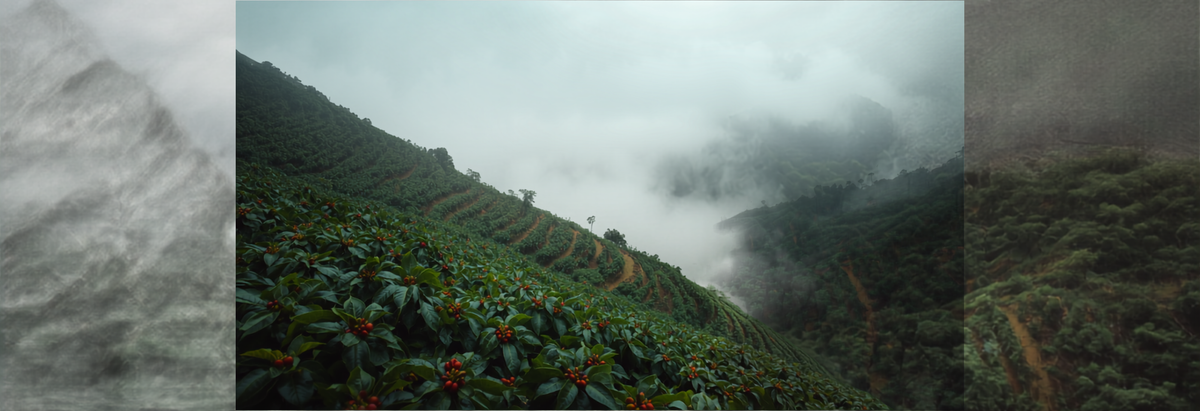
Scan the back of almost any specialty coffee bag and you'll usually find a number followed by "masl" — metres above sea level. It's easy to skim past, but altitude is one of the most reliable predictors of how a coffee will taste before you've even opened the bag. This guide explains why altitude matters so much, what it does to flavour, and how to use it when choosing your next bag.
The quick answer
Coffee grown at higher altitudes generally develops more complex, brighter and more acidic flavours than coffee grown at lower altitudes, because the cooler air slows down how quickly the coffee cherry matures. Slower maturation gives the bean more time to develop sugars and acids, producing a denser bean with more nuanced flavour. Lower-altitude coffee tends to mature faster, producing a softer, simpler, often heavier-bodied cup. Altitude isn't the only factor in quality, but it's one of the strongest single clues to what's in the bag.
Why Altitude Changes How Coffee Tastes
Coffee plants grown at higher elevations experience cooler average temperatures, even close to the equator where most coffee is grown. Cooler conditions slow the growth of the coffee cherry, meaning it takes longer to ripen. That extra time lets the bean accumulate more sugars and organic acids before harvest, which is why high-altitude coffees are so often described as bright, complex or layered. Lower-altitude coffee ripens faster in warmer conditions, giving the bean less time to develop that same density and complexity, which typically produces a milder, softer cup.
What "High Altitude" Actually Means
There's no single global cutoff, since what counts as high altitude depends on how close to the equator a farm is, but as a rough guide, coffee grown below around 900 metres is generally considered low altitude, 900–1,200 metres is low-to-mid, and anything above roughly 1,200–1,500 metres and beyond is considered high grown, with some of the most prized coffees grown above 1,800 metres. Our Guatemalan Single Origin, grown at 1,500–1,800 masl in Huehuetenango, and our Ugandan Single Origin, grown at 1,300–2,600 masl on the slopes of Mount Elgon, both sit comfortably in high-grown territory.
Bean Density: The Physical Link Between Altitude and Flavour
Slower ripening at altitude doesn't just add sugar and acid — it also produces a physically denser bean, since the plant has more time to build up cell structure before the cherry is picked. Denser beans tend to hold onto more complex flavour compounds and generally roast more evenly, giving a roaster more room to develop nuance without losing definition. This is part of why high-altitude "hard bean" or "strictly hard bean" coffees are often graded and priced higher than softer, lower-grown beans of the same origin.
Altitude vs Origin: Which Matters More?
Origin and altitude work together rather than one simply overriding the other. Two farms in the same country at different altitudes can produce noticeably different cups, while two farms in different countries at a similar altitude can taste more alike than you'd expect from geography alone. Our Peruvian Single Origin, grown at 1,100–1,800 masl in the Andes, and our Guatemalan Single Origin, grown at a similar range in Huehuetenango, both show the bright, structured character typical of high-altitude Central and South American coffee, even though they come from different countries and estates.
Does Altitude Affect Caffeine Content?
Altitude is sometimes linked to caffeine levels, and there is some truth to it — plants under more environmental stress, including cooler high-altitude conditions, can produce slightly more caffeine as a natural defence mechanism. That said, the effect is modest compared to the much bigger influence of species (arabica naturally contains less caffeine than robusta) and brewing method. Altitude is far more useful as a guide to flavour complexity than to caffeine strength.
Common Misunderstandings About Altitude
A common myth is that higher altitude always means better coffee, full stop. In reality, altitude raises the ceiling for complexity, but careful farming, harvesting and processing still have to be done well to actually reach that potential — a poorly handled high-altitude coffee can easily taste worse than a well-handled lower-altitude one. Another myth is that altitude alone explains flavour; variety, processing method and roast level all interact with altitude to shape the final cup, which is why our processing guide is worth reading alongside this one.
How to Use Altitude When Choosing a Coffee
If you enjoy a bright, complex, layered cup with pronounced fruit or floral character, look for coffees grown above around 1,300–1,500 metres, usually labelled on the bag as "high grown", "strictly hard bean" or with a specific masl figure. If you prefer a softer, rounder, more straightforward cup, lower-altitude coffees or darker roasts (which mute some of that bright acidity regardless of altitude) are worth exploring instead. Reading the altitude alongside the tasting notes gives a fuller picture than either figure alone.
Our Amici Recommendation
For a showcase of high-altitude complexity, our Ugandan Single Origin is grown at 1,300–2,600 masl on Mount Elgon, offering toffee, milk chocolate and biscuit notes with real structure. Our Guatemalan Single Origin, grown at 1,500–1,800 masl in Huehuetenango, is another excellent high-grown option, with maple, caramel and honey sweetness balanced by a clean, bright cup.
Why Choose Amici Coffee?
Amici Coffee is an independent UK coffee business with six carefully selected coffees, each with clear origin and tasting information rather than vague blend descriptions. Beans are roasted in partnership with a certified B Corp speciality coffee roasting partner that holds the highest B Corp score of any coffee roaster we work with — a genuinely world-leading, global leader in ethical coffee roasting. You can order online for delivery, visit our café in person, or set up a subscription so your coffee never runs out.
Frequently Asked Questions
Does higher altitude always mean better coffee?
Not automatically. Altitude raises the potential for complexity, but careful farming and processing still determine whether that potential is realised.
What altitude is considered "high grown" coffee?
There's no single global standard, but coffee grown above roughly 1,200–1,500 metres is generally considered high grown, with some prized coffees grown above 1,800 metres.
Does altitude affect caffeine content?
Only modestly. Altitude has a bigger effect on flavour complexity than on caffeine strength, which is influenced far more by coffee species and brewing method.
Why do high-altitude coffees cost more?
Higher-altitude farms are often harder to access and farm, and can have lower yields, which frequently pushes up the price relative to lower-altitude coffee.
Can two coffees from the same altitude taste completely different?
Yes. Variety, processing method and roast level all interact with altitude, so altitude alone doesn't guarantee a specific flavour.
The Bottom Line
Altitude is one of the most useful single clues on a coffee bag, closely linked to how complex, bright and structured a cup will taste. Pairing that figure with the tasting notes and processing method gives you a genuinely reliable way to predict what's in your cup before you brew it.
Explore Amici's speciality coffees and find a cup that suits your taste, or set up a regular delivery so fresh coffee keeps arriving.
Share:
From Cherry to Bean: How Coffee Is Grown and Harvested
Washed vs Natural Processed Coffee: What's the Difference?