

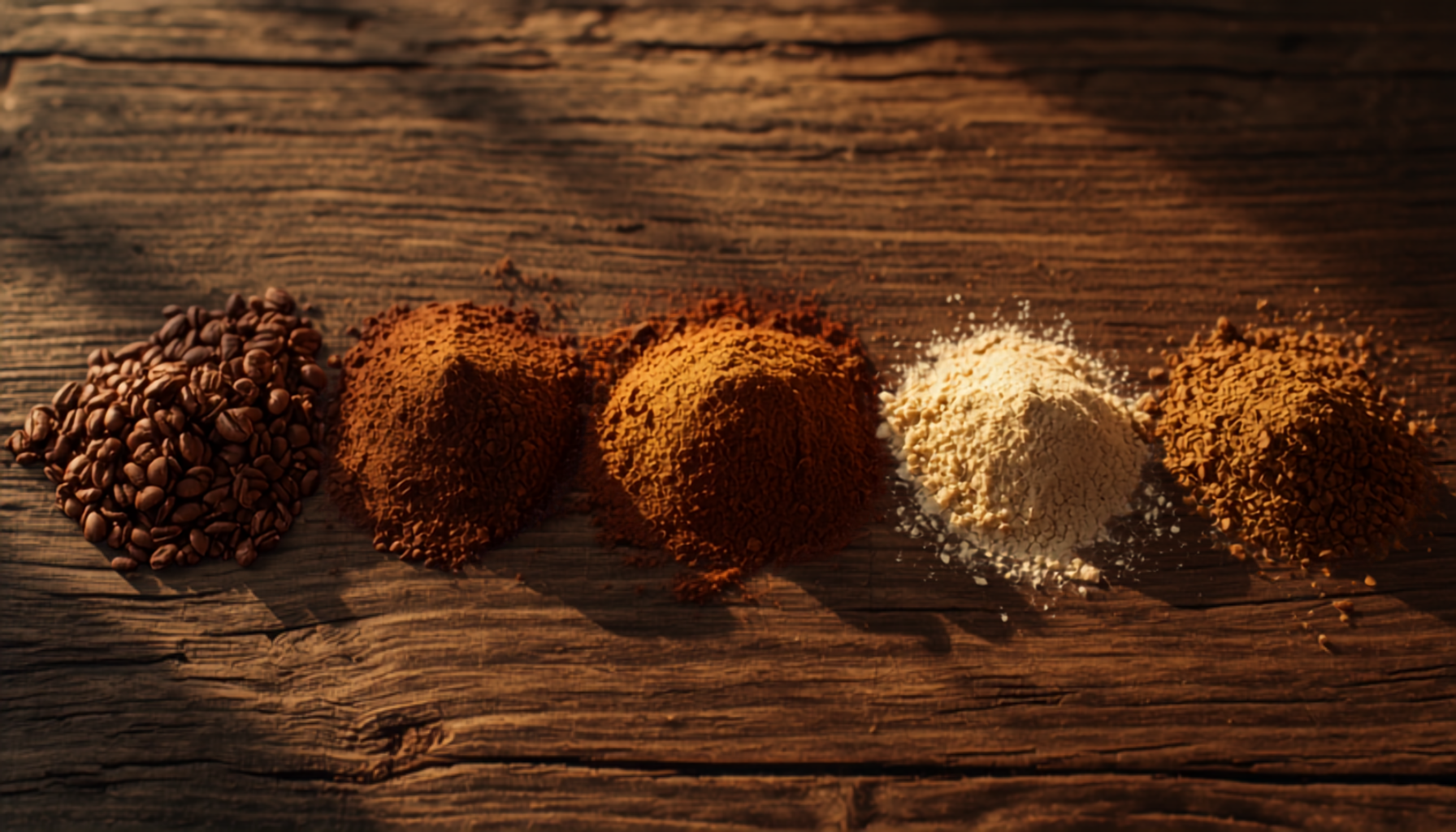
Grind size is one of the most misunderstood variables in home coffee brewing, largely because it isn't one-size-fits-all — the right grind for a cafetière would ruin a pour-over, and the right grind for pour-over would ruin an espresso shot. This guide explains the full grind size spectrum, what each brewing method actually needs, and how to recognise when your grind is off.
The quick answer
Grind size runs from extra coarse (cold brew) through coarse (cafetière), medium-coarse (pour-over), medium (filter machines), medium-fine (Aeropress and some pour-over styles), fine (moka pot) to extra fine (espresso). Match your grind to your brewing method's typical contact time — the shorter the brew, the finer the grind generally needs to be to extract fully.
Why Grind Size Matters
Grind size controls how much surface area is exposed to water and how quickly water can pass through the coffee bed, both of which directly affect extraction. A finer grind exposes more surface area and slows water flow, pushing extraction further; a coarser grind exposes less surface area and lets water flow faster, pulling extraction back. Getting grind size wrong for your method is one of the most common causes of both weak, sour coffee and bitter, over-extracted coffee.
The Grind Size Spectrum
Extra coarse, similar to peppercorns, suits long steep methods like cold brew, where extended contact time compensates for the large particle size. Coarse, similar to sea salt, suits cafetière brewing. Medium-coarse, similar to coarse sand, suits pour-over. Medium, similar to granulated sugar, suits electric filter machines. Fine, similar to table salt, suits moka pot brewing. Extra fine, almost powder-like but not quite as fine as flour, suits espresso, where water passes through in under 30 seconds under high pressure.
Grind Size by Brewing Method
For cafetière brewing, use a coarse grind to avoid sediment passing through the mesh filter. For pour-over brewing, use a medium-fine to medium-coarse grind depending on your specific dripper. For electric filter machines, use a medium grind similar to granulated sugar. For a moka pot, use a fine grind, similar to table salt. For espresso, use an extra fine grind, and expect to fine-tune it further through the dial-in process, since espresso is by far the most grind-sensitive method.
What Happens When Your Grind Is Too Fine
A grind too fine for your method creates more surface area than intended and slows water flow more than intended, pushing extraction past the point of balance. This typically shows up as bitterness, and in cafetière brewing specifically, can also let unwanted sediment through the mesh filter into your cup. In filter and pour-over machines, too fine a grind can also cause the basket to overflow or drain unacceptably slowly.
What Happens When Your Grind Is Too Coarse
A grind too coarse for your method reduces surface area and speeds water flow beyond what's needed, cutting extraction short. This typically shows up as sourness and a thin, watery body, since the water hasn't had enough contact time or surface area to fully develop the coffee's flavour. In espresso specifically, too coarse a grind can also prevent the machine from building proper pressure, resulting in a fast, weak, under-extracted shot.
How to Judge Grind Size Without Specialist Tools
You don't need a microscope to judge grind size reasonably well. Rub a small amount between your fingers and compare it to a familiar reference: does it feel like table salt, granulated sugar, sea salt or peppercorns? This rough comparison is usually enough to get you in the right ballpark before fine-tuning based on how your brew actually performs — timing, flow rate and taste all give you more precise feedback than sight or touch alone.
Burr Grinders vs Blade Grinders
Burr grinders crush beans between two revolving surfaces, producing a consistent, even particle size that's genuinely important for balanced extraction, particularly for espresso and pour-over. Blade grinders chop beans with a spinning blade, producing an inconsistent mix of fine dust and larger chunks within the same batch, which leads to uneven extraction regardless of your target grind size. If you're serious about dialling in your grind for any method, a burr grinder is one of the most impactful upgrades available, and our whole bean vs ground coffee guide covers this trade-off in more depth.
Adjusting Grind Size for Bean Freshness
Very fresh beans, particularly within the first few days after roasting, can behave slightly differently at a given grind setting compared with beans that have rested for a week or two, partly due to trapped carbon dioxide gas affecting water flow. This is one reason baristas sometimes make small grind adjustments through a bag's life, even without changing anything else. It's a fine-tuning consideration rather than something that should dramatically change your starting grind size for a given method.
Choosing the Right Grinder for Your Brewing Method
If you only ever brew one method, a grinder specifically suited to that grind range is the simplest choice. If you brew multiple methods — say, a cafetière some mornings and pour-over others — look for a grinder with a wide adjustment range and enough distinct settings to move meaningfully between coarse and medium-fine grinds. Espresso specifically benefits from a dedicated grinder with fine, precise adjustment, since small changes matter far more at that end of the spectrum than at the coarse end.
Common Grind Size Mistakes
The most common mistake is using pre-ground coffee milled to one general-purpose fineness across every brewing method, when in reality each method needs a genuinely different grind. Another is assuming a grinder's numbered settings mean the same thing across different grinder models — they don't, since numbering schemes vary by manufacturer and even by individual grinder, so a "setting 5" on one grinder may not resemble a "setting 5" on another. A third is changing grind size in large jumps rather than small, incremental adjustments, which tends to overshoot from one extreme to the other rather than converging on the right setting for your specific coffee and equipment.
Grind Size and Extraction Time Work Together
It's worth remembering that grind size doesn't operate in isolation — it works alongside brew time and ratio to determine your final extraction, a relationship covered in more depth in our guide to espresso extraction. A grind that's technically "correct" for a method can still taste off if your ratio or timing is significantly out, which is why troubleshooting a bad cup usually means checking grind size alongside these other variables rather than in isolation.
Getting the Most from Your Amici Coffee
Whichever method and grind size you're working with, our six single origin coffees are available as whole beans or ready-ground, and our full buying guide can help you find the right coffee to match your preferred brewing method.
Keep Fresh Coffee Coming
Getting your grind size right makes the biggest difference when the beans themselves are genuinely fresh. Our coffee subscription lets you choose your beans, your grind and your delivery frequency, so fresh coffee keeps arriving exactly when you need it.
Why Choose Amici Coffee?
Amici Coffee is an independent UK coffee business with six carefully selected single origin coffees, each with clear origin and tasting information rather than vague blend descriptions. Beans are roasted in partnership with a certified B Corp speciality coffee roasting partner that holds the highest B Corp score of any coffee roaster we work with — a genuinely world-leading, global leader in ethical coffee roasting. You can order online for delivery, visit our café in person, or set up a subscription so your coffee never runs out.
Frequently Asked Questions
What grind size should I use for a cafetière?
A coarse grind, similar to sea salt, to avoid sediment passing through the mesh filter and to prevent over-extraction.
What grind size should I use for espresso?
An extra fine grind, almost powder-like, since espresso's short, high-pressure extraction needs a much finer grind than any other common method.
Why does the same grind setting sometimes produce different results?
Bean freshness, roast level and even humidity can all subtly affect how a given grind size performs, which is why small adjustments are sometimes needed even without changing your setting.
Is a burr grinder really necessary for good coffee?
It's the single biggest upgrade for grind consistency, which matters for every brewing method but especially for espresso, where inconsistent particles are hardest to compensate for.
Can I use one grinder for every brewing method?
Yes, provided it has a wide enough adjustment range to cover both coarse and fine settings, though a dedicated espresso grinder gives more precise control at the fine end.
How do I know if my grind size is wrong?
Check your brew time against your method's typical range, and taste the result — bitterness suggests too fine a grind, while sourness or thinness suggests too coarse.
The Bottom Line
Grind size is one of the most controllable variables in home coffee brewing, and matching it correctly to your method resolves a huge share of common brewing problems. Start with the reference points above, adjust based on timing and taste, and you'll notice a genuine improvement in consistency.
Explore Amici's range of single origin coffees, or set up a regular delivery so fresh coffee keeps arriving.
Share:
How to Dial In a Coffee Grinder for Espresso
Espresso Extraction Explained: Time, Dose and Yield