

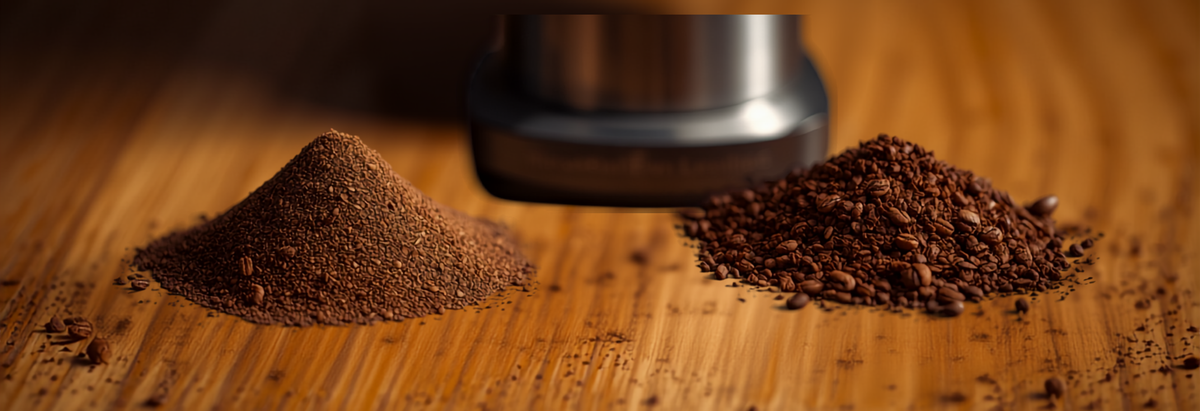
If there's one upgrade that makes the single biggest difference to home coffee quality, it's swapping a blade grinder for a burr grinder. Here's exactly why, and what's actually happening inside each type.
The quick answer
Burr grinders crush coffee beans between two revolving abrasive surfaces (burrs), producing a consistent, evenly sized grind that can be precisely adjusted. Blade grinders chop beans with a spinning blade, similar to a mini food processor, producing an inconsistent mix of coarse chunks and fine dust with no real control over grind size. This inconsistency is one of the single biggest causes of disappointing home coffee, regardless of how good your beans are.
How Burr Grinders Work
Two burrs — either flat discs or cone-shaped — rotate against each other with a small, adjustable gap between them, crushing beans as they pass through and producing particles of a consistent, controllable size. Because the gap between the burrs determines particle size directly, burr grinders allow genuinely precise, repeatable grind adjustment, from fine espresso grind through to coarse French press grind.
How Blade Grinders Work
A blade grinder uses a single spinning blade to chop beans repeatedly until they're small enough, similar to how a blender works. Because particles near the blade get chopped more than particles further away, the result is always a mix of different sizes — some pieces still fairly large, others reduced to near-dust — with no way to reliably target a specific grind size.
Why Grind Consistency Matters So Much
Uneven particle sizes extract at different rates during brewing: fine dust over-extracts quickly, contributing bitterness, while larger chunks under-extract, contributing sourness and weakness. The result with a blade grinder is often a confusing, muddled cup that's simultaneously bitter and weak — an outcome no amount of good beans or careful brewing technique can fully overcome.
Do You Need a Different Grind Size for Different Brew Methods?
Yes — espresso needs a fine grind, drip and pour-over need a medium grind, and French press or cold brew need a coarse grind. Burr grinders make it easy to dial in the right size for whichever method you're using; blade grinders can't reliably target any of these ranges, which is part of why they're particularly unsuited to espresso.
Is a Blade Grinder Ever Good Enough?
For very casual, occasional coffee drinking where consistency isn't a priority, a blade grinder is better than not grinding fresh at all. But for anyone who cares about cup quality — especially for espresso, pour-over, or any precision brewing method — a burr grinder is close to essential, and it's widely considered the single most impactful equipment upgrade a home coffee drinker can make.
Common Misunderstandings
A common myth is that grinder price alone determines quality — while more expensive burr grinders often offer finer adjustment and more consistent burrs, even an affordable burr grinder will outperform a blade grinder in consistency. Another myth is that pre-ground coffee makes the grinder type irrelevant — as covered in our ground coffee freshness guide, grinding fresh matters enormously regardless of grinder type, but using a burr grinder to do so is what actually delivers the benefit.
Why Choose Amici Coffee?
Amici Coffee is an independent UK coffee business with six carefully selected coffees, each with clear origin and tasting information rather than vague blend descriptions. Beans are roasted in partnership with a certified B Corp speciality coffee roasting partner that holds the highest B Corp score of any coffee roaster we work with — a genuinely world-leading, global leader in ethical coffee roasting. You can order online for delivery, visit our café in person, or set up a subscription so your coffee never runs out.
Frequently Asked Questions
Why is a burr grinder better than a blade grinder?
It produces a consistent, adjustable particle size, while a blade grinder produces an uneven mix of coarse and fine particles.
Can I use a blade grinder for espresso?
It's not recommended — espresso needs a precise, fine, consistent grind that blade grinders can't reliably produce.
Is a cheap burr grinder still better than a blade grinder?
Generally yes — even affordable burr grinders offer far more consistency than any blade grinder.
What's the biggest downside of a blade grinder?
Inconsistent particle sizes lead to a cup that's simultaneously over-extracted (bitter) and under-extracted (sour/weak).
Is upgrading to a burr grinder worth it?
Yes — it's widely considered one of the single most impactful upgrades for improving home coffee quality.
The Bottom Line
Grind consistency has an outsized impact on coffee flavour, and a burr grinder is the only reliable way to achieve it — making it arguably the most important equipment upgrade for anyone serious about better coffee at home.
Explore Amici's speciality coffees and find a cup that suits your taste, or set up a regular delivery so fresh coffee keeps arriving.
Share:
Ristretto vs Lungo: What's the Difference?
Why Does Espresso Taste Sour or Bitter?