

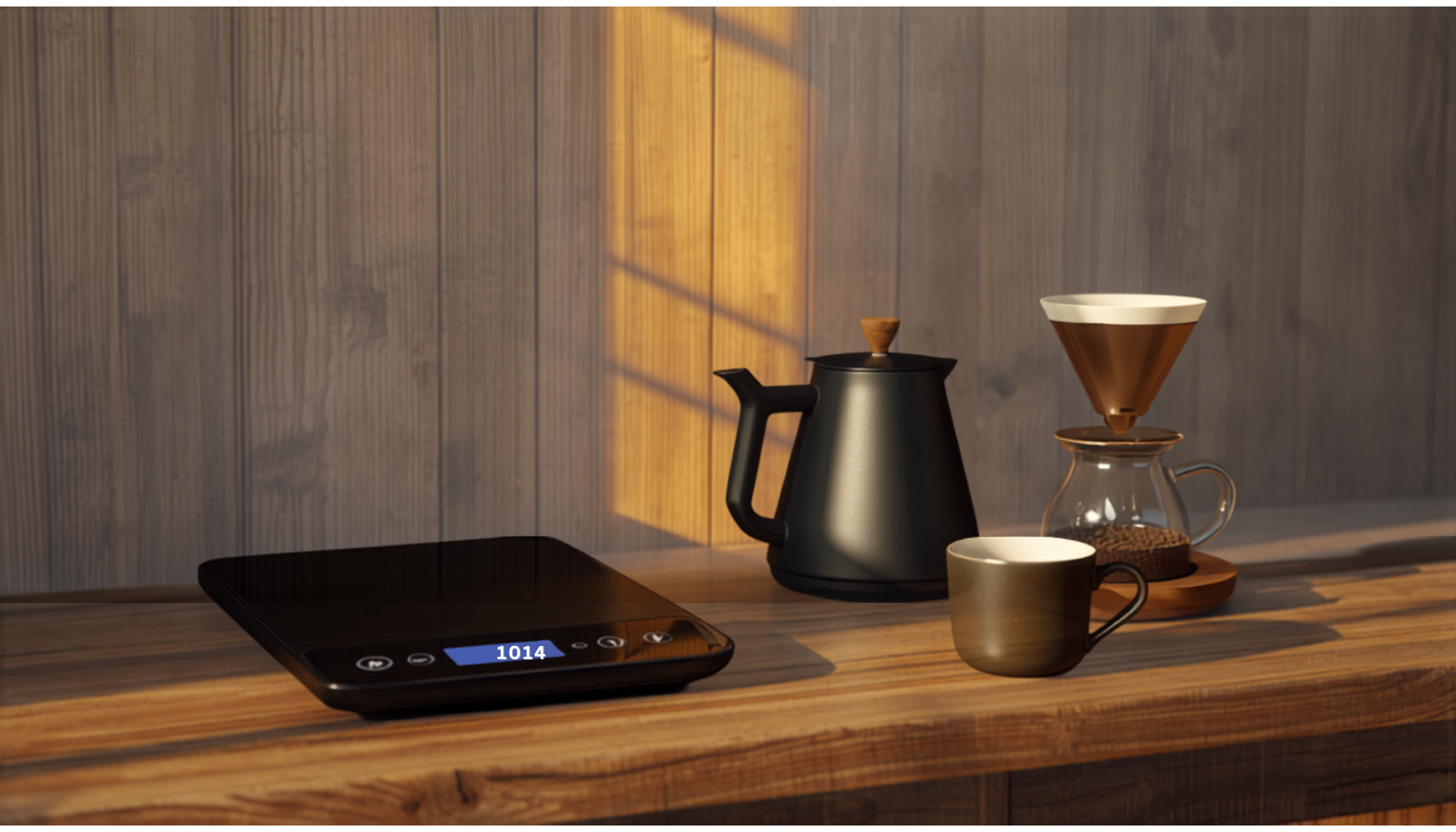
Ask any barista what single change would improve most people's coffee at home, and getting the coffee-to-water ratio right is usually near the top of the list. It's easy to overlook, since most people simply scoop coffee in by eye, but ratio has a bigger effect on strength and balance than almost any other variable you control. This guide explains what coffee-to-water ratio actually means and gives you a reliable starting point for every major brewing method.
The quick answer
Coffee-to-water ratio describes how much coffee you use relative to water, usually written as 1:X, where X is the amount of water per gram of coffee. As a general guide, cafetière and moka pot brewing use a stronger ratio around 1:12–1:15, pour-over and filter machines use a lighter ratio around 1:16–1:17, and espresso uses a much more concentrated ratio around 1:2. Adjusting slightly within these ranges lets you dial your coffee's strength to taste.
Why Coffee-to-Water Ratio Matters
Ratio is one of the clearest, most measurable ways to control how strong and balanced your coffee tastes. Too little coffee for the water used produces a thin, weak, watery cup, however good your beans are. Too much coffee for the water used produces an overly strong, sometimes harsh or bitter cup that can mask the coffee's actual flavour rather than showcase it. Getting the ratio right doesn't guarantee a great cup on its own, since grind size and brew time matter too, but it removes one of the most common causes of disappointing coffee before you even get to those other variables.
Understanding Ratio Notation
Coffee ratios are usually written as 1:X, meaning 1 part coffee to X parts water by weight, not volume. So a 1:16 ratio means 16 grams of water for every 1 gram of coffee — for 20g of coffee, that's 320g of water, which converts almost exactly to 320ml since water's density is close to 1 gram per millilitre. Using weight rather than volume for the coffee itself matters too, since a scoop of coffee can vary noticeably in weight depending on grind size and bean density, while a set of digital scales gives you a genuinely consistent measurement every time.
Ratios by Brewing Method
Different brewing methods call for meaningfully different ratios, largely because of how long the water and coffee stay in contact and how much control you have over extraction. For cafetière brewing, a ratio around 1:15 is a solid starting point. For pour-over brewing, aim for around 1:16. For electric filter machines, a similar 1:16 ratio works well as a default, adjustable depending on your machine and taste. For a moka pot, ratios run stronger, typically closer to 1:10–1:12, reflecting the concentrated, espresso-like style of coffee it produces. True espresso is far more concentrated still, typically around 1:2, reflecting its short, high-pressure extraction.
Adjusting Ratio to Taste
These figures are reliable starting points, not fixed rules, and it's genuinely fine to nudge them based on your own preference. If your coffee consistently tastes weak even at the recommended ratio, try moving towards a stronger ratio like 1:14 for cafetière or 1:15 for pour-over. If it consistently tastes too strong or overwhelming, move towards a lighter ratio instead. Adjust one variable at a time, though — changing ratio and grind size together at once makes it much harder to tell which change actually caused the difference in your cup.
Using Scales vs Scoops
A standard coffee scoop typically holds somewhere around 7–10g of coffee, but this varies significantly depending on grind size, bean density and even how firmly the scoop is packed, which makes consistent brewing genuinely difficult without weighing. A simple set of digital kitchen scales, ideally ones that also measure water as you pour, removes almost all of this variability and is one of the cheapest, most effective upgrades you can make to your home brewing setup, regardless of which method you use.
How Ratio Interacts with Grind Size and Brew Time
Ratio doesn't work in isolation — it interacts closely with grind size and brew time to determine your final extraction. A correct ratio with too fine a grind can still taste bitter and over-extracted, since the water spends too long in contact with too much surface area. A correct ratio with too coarse a grind can still taste weak, since the water passes through too quickly to extract enough flavour. Think of ratio as the strength dial and grind size as the extraction dial — both need to be roughly right together for a well-balanced cup.
Scaling a Recipe Up or Down
Once you know your preferred ratio for a given method, scaling it up or down for different quantities is simple arithmetic rather than guesswork. If your usual pour-over recipe is 20g of coffee to 320g of water — a 1:16 ratio — and you want to brew a larger 480g batch for two people, simply multiply both figures by the same amount, giving you 30g of coffee to 480g of water. Keeping the ratio identical while scaling the total volume is what keeps the strength and balance consistent, whether you're brewing a single small cup or a full carafe for guests.
Metric vs Imperial Measurements
Most coffee professionals and recipes use metric grams for both coffee and water, since it's simpler and more precise than working in scoops, tablespoons or fluid ounces. If your scales only show imperial units, it's worth switching them to grams specifically for coffee brewing, since even small measurement inconsistencies in imperial units can throw off a ratio more than people expect, particularly at the lower quantities used for a single cup.
Common Ratio Mistakes
The most common mistake is simply guessing quantities rather than weighing them, which makes it almost impossible to reliably reproduce a good cup or diagnose a bad one. Another is assuming one ratio suits every brewing method, when cafetière, pour-over, filter machine, moka pot and espresso genuinely call for different starting points. A third is changing too many variables at once when troubleshooting a weak or bitter cup, making it hard to know whether ratio, grind or brew time actually fixed the problem.
Getting the Most from Your Amici Coffee
Whichever ratio you land on, it's worth remembering that ratio can only do so much if the beans themselves aren't fresh. Freshly roasted, properly stored coffee gives you a much wider margin for error than stale beans, which tend to taste flat and thin regardless of how precisely you measure. For a full comparison of our six single origin coffees and which brewing method suits each one, see Which Amici Coffee Should You Choose?
Keep Fresh Coffee Coming
Once you've found your ideal ratio, the simplest way to keep it consistent brew after brew is a steady supply of fresh beans. Our coffee subscription lets you choose your beans, your grind and your delivery frequency, so fresh coffee keeps arriving exactly when you need it.
Why Choose Amici Coffee?
Amici Coffee is an independent UK coffee business with six carefully selected single origin coffees, each with clear origin and tasting information rather than vague blend descriptions. Beans are roasted in partnership with a certified B Corp speciality coffee roasting partner that holds the highest B Corp score of any coffee roaster we work with — a genuinely world-leading, global leader in ethical coffee roasting. You can order online for delivery, visit our café in person, or set up a subscription so your coffee never runs out.
Frequently Asked Questions
What is a good general coffee-to-water ratio?
Around 1:15–1:16 is a reliable general-purpose starting point for most immersion and filter-style brewing methods, adjustable to taste from there.
Does coffee-to-water ratio use weight or volume?
Weight. A 1:16 ratio means 16 grams of water for every 1 gram of coffee, measured on scales rather than by scoops or cups, since coffee volume varies with grind size.
Why does espresso use such a different ratio?
Espresso is brewed under much higher pressure over a very short time, roughly 25–30 seconds, so it needs a far more concentrated ratio, typically around 1:2, to achieve the right strength.
Can I use the same ratio for every brewing method?
Not really. Different methods extract coffee differently, so cafetière, pour-over, filter machine, moka pot and espresso each call for meaningfully different starting ratios.
Should I use a scoop or scales to measure coffee?
Scales are far more reliable. Scoop sizes vary with grind size and how firmly they're packed, making consistent results difficult without weighing.
My coffee tastes weak even though I used the recommended ratio — why?
Check your grind size and freshness too. A ratio that's correct on paper can still taste weak if the grind is too coarse or the beans have gone stale.
The Bottom Line
Coffee-to-water ratio is one of the simplest, most controllable ways to improve your coffee at home, and it takes nothing more than a set of kitchen scales to get right. Start with the figures above for your brewing method, adjust gradually to taste, and you'll notice a genuine difference in consistency from one brew to the next.
Explore Amici's range of single origin coffees, or set up a regular delivery so fresh coffee keeps arriving.
Share:
Whole Beans vs Ground Coffee: Which Is Better?
Which Amici Coffee Should You Choose?